It’s the end of the quarter, and your employees have achieved unprecedented levels of growth. Or maybe a manager just closed a major deal. Or it’s the 15-year work anniversary of one of your most dedicated employees.
There are many reasons you might want to express appreciation to your employees. Regular acknowledgment of your team’s contributions, drive, and milestones shows them you truly care about the work they bring to your cause.
But how can you show how much their support means to you?
In this guide, we’ll explore tips for creating an effective employee recognition program and brainstorm easy ways to build a culture of gratitude within your organization. Once appreciation becomes a habit, celebrating your team’s wins gets easier with every new achievement.
We’ll cover:
- Employee Recognition FAQs
- Tips to Create an Effective Employee Recognition Program
- Best Ideas for Recognizing Employees
- Additional Recognition Resources
Employee Recognition FAQs
What is employee recognition?
Employee recognition is the practice of acknowledging employees’ contributions, behaviors, and milestones in ways that are specific, timely, and visible. Recognizing someone at work effectively means naming the exact action, describing its impact, and delivering the acknowledgment close to when the behavior occurred, not at the next quarterly review.
Sample recognition message: “Alex, your work on the Q2 client presentation was exceptional. You turned a complex dataset into a story the whole room understood, and it directly contributed to the contract renewal. That communication skill is exactly what this team needs more of.”
Why is employee recognition important?
Employee recognition matters because it shows people their work is valued, which motivates them to perform at their best. When employees feel appreciated, they’re more engaged, more productive, and more likely to stick around.
Based on research from Zippia, here’s why recognizing employees makes such a big difference:
- It improves workplace engagement. 37% of employees report that recognition from their superiors is the best way to improve employee engagement. In other words, positive feedback from management can cultivate a more engaged workforce.
- It impacts productivity. 80% of employees would be motivated to work harder if they felt recognized by their superiors. A simple acknowledgment of a job well done could positively impact productivity.
- It reduces turnover. Turnover rates are reduced by 31% when effective employee recognition programs are in place. In fact, employees are nearly six times more likely to stay at their jobs when they feel recognized, meaning your organization can retain employees by taking the time to acknowledge their hard work.
- It inspires people to repeat certain actions. 92% of employees are likely to repeat a specific action if they are recognized for it. Your company can encourage patterns of productivity by rewarding hard work.
Ultimately, effective recognition humanizes the workplace. Showing gratitude for your employees makes them feel valued as human beings. If you spotlight your employees’ unique attributes and accomplishments, they’ll feel noticed for something exclusive to them.
What are the different types of employee recognition?
Recognition is circumstantial. It depends on the reason, the person giving it, and how it’s communicated. Some common types of recognition include:
- Formal recognition: This type of employee recognition accompanies a formal ceremony or standardized process. For example, you might shout out an employee in a company-wide email or praise their efforts in a speech at an in-person event.
- Informal recognition: Sending a note or praising an employee in a one-on-one conversation is considered informal recognition. This type of recognition is more casual, but small thank-yous for daily achievements make employees feel appreciated for their typical tasks.
- Top-down recognition: Employee recognition from a supervisor is called top-down recognition. Every employee with a supervisor can receive top-down recognition, even if they’re in a management position.
- Peer-to-peer recognition: Building team rapport contributes to a healthy workplace culture, but it can’t be accomplished through recognition from the higher-ups alone. By enabling employees to recognize their peers, they can show appreciation to each other for their hard work.
Employee recognition varies depending on what the employee is being recognized for. For example, let’s say you have an employee named John. A group of coworkers might thank John for going above and beyond on a recent project or throw a party to celebrate his fifth anniversary at the company. Both are peer-to-peer recognition, but they’re celebrating different things. A balanced peer recognition program intentionally uses both to address different stages of the employee lifecycle.
What makes a recognition message effective?
- Name the specific action. “Your Q2 client presentation” is more meaningful than “your recent work.” Specificity proves the recognition is genuine, not routine.
- State the impact. Connect the action to an outcome: the client renewed, the project shipped on time, the team stayed on budget. Impact validates that the contribution mattered.
- Send it fast. Recognition sent within 24 to 48 hours lands when the employee’s emotional response is strongest. Delayed recognition feels procedural.
- Make it visible. Public recognition in a team channel or a digital eCard shared with the wider team amplifies the signal and models the behavior for peers.
- Match the format to the magnitude. A chat message works for a daily win. A branded digital eCard, a formal award announcement, or a handwritten note fits a major milestone.
What should you recognize your employees for?
- Workplace accomplishments: Achieving goals, excelling in performance, demonstrating leadership, fostering teamwork, driving innovation, and delivering exceptional customer service.
- Milestones and longevity: Celebrating service anniversaries, career milestones, or significant achievements.
- Personal growth and development: Completing training programs, earning certifications, or advancing skills.
- Community and cultural contributions: Representing company values, supporting diversity, or participating in community and corporate responsibility efforts.
Effective recognition strategies enhance employee engagement and performance by encouraging valuable work, strengthening workplace culture, and boosting job satisfaction.
How often should employees be recognized?
Best practice is weekly informal recognition (peer kudos, manager shout-outs), monthly structured recognition (nominated awards, team spotlights), and annual formal milestones (work anniversaries, tenure awards, company-wide achievements). Employees who go more than 7 days without recognition report measurable drops in engagement.
What are good recognition eCards for employees?
Good employee recognition eCards are branded to the company, reference a specific achievement or milestone, come from a named sender (not “HR Team”), include imagery aligned with the moment (work anniversary, peer kudos, project win), and optionally carry a small perk like a gift-card link or time-off credit for high-impact recognition.
What is an employee recognition program?
An employee recognition program is a system designed to acknowledge and reward employees for the contributions, achievements, and behaviors that support the organization’s goals and values. With a thoughtful recognition plan, your appreciation becomes consistent, meaningful, and impactful, fostering employee engagement and a positive workplace culture.
An effective employee recognition program has three key qualities:
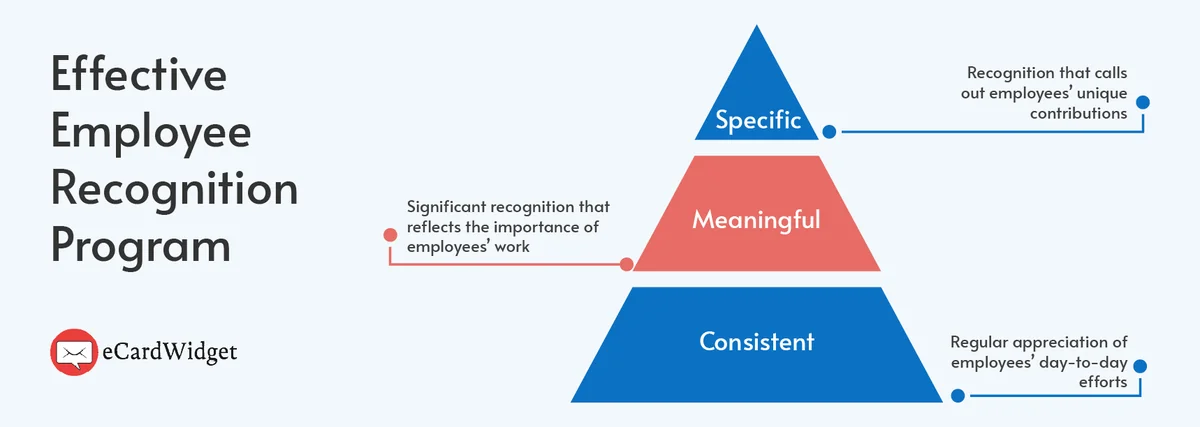
- Consistent: Regularly acknowledge employees to reinforce the message that their daily efforts contribute to the organization’s success.
- Meaningful: Ensure employees feel valued by highlighting the importance of your recognition efforts, helping them see the direct impact of their work.
- Specific: Recognize employees for their unique contributions with clear and personalized appreciation, avoiding generic gestures that feel impersonal or routine.
Many organizations use specialized employee recognition software to simplify and enhance their appreciation efforts, such as platforms for peer-to-peer recognition, performance tracking, and rewards management. These tools help facilitate consistent recognition, enable personalized acknowledgments, and streamline tracking and rewarding employee achievements.
Tips to Create an Effective Employee Recognition Program
Creating an effective employee recognition program doesn’t have to be complicated, but it does require thoughtful planning. If you’re unsure where to start, experiment with these strategies:
1. Ask employees how they prefer to be recognized.
Every employee is different, but to truly make them feel appreciated, recognition must be specific and meaningful to them. We recommend surveying your employees to determine how they prefer to be recognized. Here are some aspects to ask about:
- Public or private: Would your employees rather be in the spotlight or be recognized in private?
- Verbal or tangible: Would your employees rather receive verbal praise or a tangible gift?
- Peer or management: Would your employees prefer recognition from coworkers, leaders, or both?
Keep in mind that different occasions call for different types of celebrations. For example, you might create an eCard to thank an employee for handling a difficult client situation, but host a company-wide party to celebrate their promotion.
2. Consistently recognize employees.
For your efforts to be effective, they must be timely and consistent. Regular recognition reminds employees that their contributions are valued continuously, not just during major milestones.
Create a structured employee recognition program with defined timelines, such as monthly awards, weekly shout-outs, or daily acknowledgments. Train managers to spot opportunities for recognition and incorporate appreciation into their routine interactions. You can also use employee recognition platforms that send reminders, automate milestone acknowledgments, and allow for instant recognition.
3. Implement convenient methods.
Convenient methods remove barriers and make showing appreciation an effortless part of your company culture. Make participating easy and accessible to managers and peers alike.
For example, tools like recognition platforms, mobile apps, or team chats let employees quickly send a thank-you or celebrate a colleague’s achievement in real time. Pre-made templates for emails, shout-outs during meetings, and digital rewards ensure that recognition happens frequently without unnecessary delays.
Best Ideas for Recognizing Employees
Employee recognition comes in many forms. Here are nine employee recognition ideas that will make your employees feel valued, whether they’ve just made a notable sale or earned a new certification.
1. Recognition eCards
Create employee recognition eCards that your managers and employees can send to celebrate successes. With eCardWidget, you can create branded eCards that celebrate employees who exemplify company values, go above and beyond in their roles, and advance their skills outside the workplace.
Try these creative ways to use work eCards:
- Share kudos. Celebrate employees for their accomplishments, from work anniversaries to small daily triumphs. For example, you could create eCard templates that celebrate each of your company’s values. Then, when an employee exhibits one of those values in their work, send an eCard to thank them.
- Call out client satisfaction. Share a positive review that praises an employee or team through an eCard. This can especially help engage hybrid or remote employees who might not be part of the daily in-office conversations that highlight these achievements.
- Support personal milestones. Send eCards to employees who have recently purchased a new home, gotten married, adopted a new pet, or accomplished something else significant in their personal lives. This shows that you care about more than just their work performance. You’re invested in them as individuals.
- Celebrate special occasions. Prepare eCards for holidays and employees’ birthdays with classic party animations like confetti and party poppers. With our automated birthday eCard feature, you can schedule celebratory eCards to be sent from company leadership automatically on each employee’s birthday. Upload each contact’s birthday, select a few birthday-themed designs, and write thoughtful messages. If you choose multiple designs or write multiple birthday messages, the platform picks a different combination for each birthday.
- And many more. eCardWidget lets you create completely customized eCards, so you can send a card for any occasion. The opportunities are endless.
To encourage recognition further, enable employees to shout out coworkers by sending eCards. Remember, you can always use eCard scheduling to send cards on later dates (like birthdays or work anniversaries).
As a bonus, our eCards are versatile. Create designs to build customer relationships or to market your products and services.
A Real Example of This Employee Recognition Strategy
Modivcare needed a consistent way to celebrate personal milestones like birthdays, promote company values, and show employees that the company cared about them. That’s where eCardWidget came in.
Modivcare chose eCardWidget to power its first formal recognition program. Backed by our intuitive eCard platform, the company’s leaders created designs for every occasion: birthdays, work anniversaries, and more. There were even designs to call out exceptional work aligned with company values like transparency, teamwork, and respect.
Employees and managers could send these to celebrate workplace successes and personal milestones. They simply added sender and recipient information and a custom note of appreciation. Leadership also received copies of every eCard, keeping them looped into performance. With more than 6,500 eCards sent, this employee recognition idea worked wonders for company culture and team camaraderie.
2. Paid Time Off
The American Psychological Association’s Work in America Survey found that the 42% of employees who feel they matter to their employer experience better emotional and psychological health than those who do not. Time off is a wonderful way to help people rejuvenate, so use it as a reward in your employee recognition program.
There are several ways you might use breaks as a special thank-you for employees. You might let them:
- Start the work day late.
- End the work day early.
- Take the whole day off.
- Take an extended break, like a two-hour lunch.
When you give employees a break, you show that you view them as human beings rather than a source of labor. Humanizing the workplace not only helps employees feel recognized but also creates a family-like atmosphere in which they’ll want to work.
3. Compensation
Many people are highly motivated by financial returns. Bonuses, raises, or performance-based incentives reward excellence. You might add money directly to their paycheck or offer a gift card. This type of recognition directly impacts employees’ financial well-being, motivating them to continue excelling. By aligning compensation strategies with achievements, you can foster loyalty and drive sustained productivity.
4. Experiences
Provide unique experiences for employees to enjoy. Some exciting experiential gifts might include:
- Wine tasting tour
- Cooking class
- Spa day
- Sports event tickets
- Concert tickets
Customize your company’s gifts to each employee to make them more meaningful. For example, if one of your employees is especially stressed out, consider gifting them a spa day.
5. Free Meals
Put lunch on the company card every once in a while, and not just as a reward for meeting a certain goal. Instead, host these lunches regularly to get to know your employees better and strengthen office relationships. For example, schedule quarterly lunches with each team.
6. Charitable Donations
Successful employee recognition programs align with a company’s mission and values. After all, your employees want to see your organization operate in line with its proclaimed values.
Provide opportunities for charitable giving to organizations that align with your company’s values. For example, reward outstanding work by donating to a nonprofit an employee cares about, such as one where they regularly volunteer. This tells them you notice their interests outside of work.
Try these ways to include employees in corporate philanthropy:
- Tribute donations: For example, donate $100 to their favorite charity in their name.
- Matching gifts: Create a formal program where you donate a predetermined amount to a nonprofit every time an employee gives. For example, if your employee donates $10 monthly to a local animal shelter, your company can match their donation.
- Volunteer grants: Donate to a nonprofit every time an employee volunteers a certain number of hours. For example, you might give a $25 grant for every hour volunteered at a food bank to thank employees for their hard work, both in the office and in the community.
Charitable donations show your employees that you live your company values, and they make employees feel recognized when you include them in the donation process. Share a list of supported charities with employees and explain why your company supports those organizations.
7. Social Media Shoutouts
Look for ways to feature your employees on social media. This intangible employee recognition idea is a small gesture that goes a long way. You might:
- Spotlight individual achievements by highlighting an employee’s outstanding accomplishments. Include their photo and a brief description of their contribution.
- Recognize team efforts or milestones with a post that mentions each member and their impact on the project.
- Publicly acknowledge anniversaries, promotions, or other milestones with a post that expresses gratitude for an employee’s dedication and highlights their achievements.
Plus, public employee recognition is a good way to show customers and potential recruits that you value your team members and reward hard work.
8. Trophies, Certificates, or Plaques
Anyone who earned a trophy for a high school sport or club likely remembers feeling accomplished. Take a similar approach to recognizing employees by creating themed trophies tied to different workplace awards. For example, order a trophy of a person answering a phone for your outstanding receptionist. Then, have it engraved to say “Front Desk Superstar.” This is a fun way to reward your employees for their hard work.
Then, create opportunities to present awards, such as:
- At a dedicated award ceremony. At a company dinner or party, call out employees’ names, their award titles, and the reason for that award.
- With an office announcement. For a casual approach, announce the award to the office during the work day or a team meeting.
- With a trophy shelf or achievement wall. Place a shelf or dedicate an office wall to employee awards. You might keep trophies or awards on display for a month before employees take them home. Then, refresh the awards to show appreciation for a new group of employees.
Tangible rewards can be especially meaningful. Plus, creating trophies and presenting them can be a fun office tradition that your employees look forward to.
9. Employee Appreciation Day Celebration
National Employee Appreciation Day is the first Friday of March each year. Treat it like the other holidays your company celebrates. You might pay special attention to this day by:
- Decorating the office
- Offering time off, like a half-day or extended break
- Throwing a party
- Buying gifts for your employees
By making a special effort to celebrate your employees and thank them for their hard work, you’ll create a work environment where employees feel important and valued. Not only will this make them happy to work for your organization, but it will boost the office attitude overall.
Aside from Employee Appreciation Day, you can also celebrate other industry-specific appreciation days, such as Administrative Professionals Day or National Nurses Day.
Additional Resources on Employee Recognition
Developing a meaningful employee recognition program reminds your employees just how valuable they are. You’ll enhance company culture and make employees happier to keep working for your company. eCards are the simplest way to make appreciation convenient, instant, and memorable.
To fully master employee recognition, check out these free resources:
- Remote Employee Recognition: Why it Matters and 13 Ideas. Don’t let virtual work stand in the way of showing your appreciation frequently or meaningfully. Check out our guide to remote recognition for ideas that will help you engage your employees, no matter where they’re working from.
- 18 Best Corporate Gifting Companies To Impress Constituents. Do you want to get a gift for your employees, but you’re not sure where to turn? Explore our recommendations for the best corporate gifting companies to kickstart your search.
- Empower Progress: 10+ Employee Engagement Software + Tips. The right tools can make a huge difference in your ability to properly acknowledge and thank your employees. Learn which tools are the most engaging in this guide.
- 50+ Thank-You Messages for the Team. Ready-to-send messages for project wraps, milestones, and daily appreciation.
- Christmas Messages for Employees. 60+ templates from CEOs, team leads, and peers.